Interactive Embodied Emotional Experience (IEEE)
Tapio Takala, Helsinki University of Technology
Research plan summary
Our general aim is to develop interactive media technology towards creative and experiential applications. Besides solid expertise in technology, we need also deeper understanding of human behavior, and design knowledge about usable application concepts. A central trend is post-WIMP interaction, i.e. human-computer interaction that radically differs from the usual desktop metaphor. This includes such themes as multimodality, gestures, emotions, soft inference, and narrative.
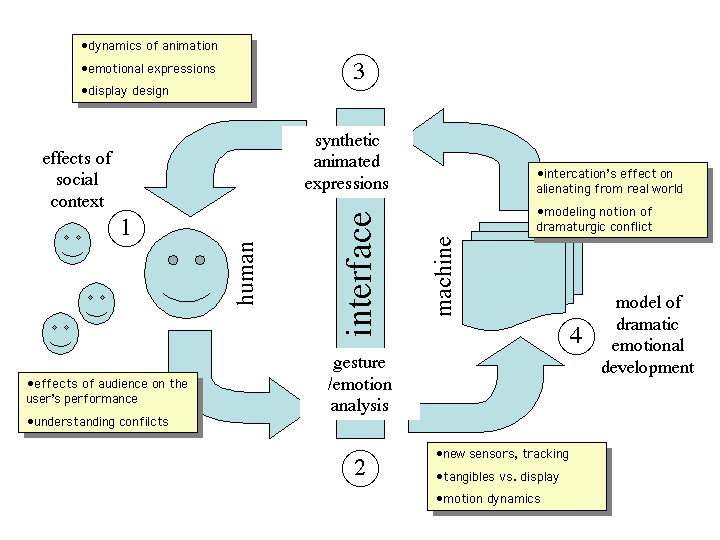
The goal of this project is symmetric communication, utilizing man's natural bodily affordances that carry emotional meaning, such as gestures, expressions and movement in space. The computer then responds by the same means, reflecting corresponding emotions. For this we need research in
- understanding the cognitive-psychological meaning of "experience"
- recognition and interpretation of gestures and other motion
- synthetic gestures and expressions on animated characters, and
- a computational model of emotions, intentions and expectations.
Our hypothesis is that if the human experiences the system as natural, it probably models the right features of behavior. Thus our research method is constructive, we build working prototypes of experiential games, performances, etc. and test the closed-loop interaction with human users. In order to avoid distracting factors, these systems are to be aesthetically well designed.
Specific research questions include
- what factors contribute to the strength and kind of an experience,
- relations between emotions and the timing of motion, and new technology for sensing and recognizing these,
- how to control the motion of animated faces and bodies to produce desired emotional expressions, e.g. by means of digital signal processing, and
- modeling of natural alternation of emotions based on the principles of classical drama, and the effects of this on the interpretation and control of expressions.
Organization
The project is carried out by the Art & Magic group at Telecommunication Software and Multimedia Laboratory, and is funded by the Academy of Finland for time span 2006-2008.
Our research facilities include an immersive virtual environment EVE, and a theater-like space Odeion, well equipped with sensoric devices and audiovisual displays.
Key personnel:
This page updated 8 Feb 2006 by Tassu Takala